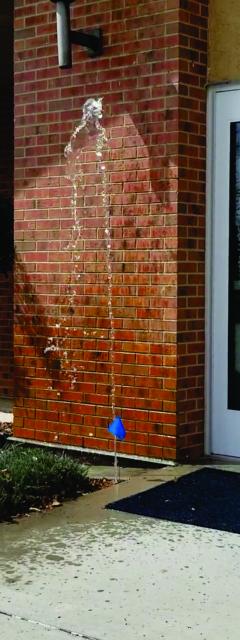


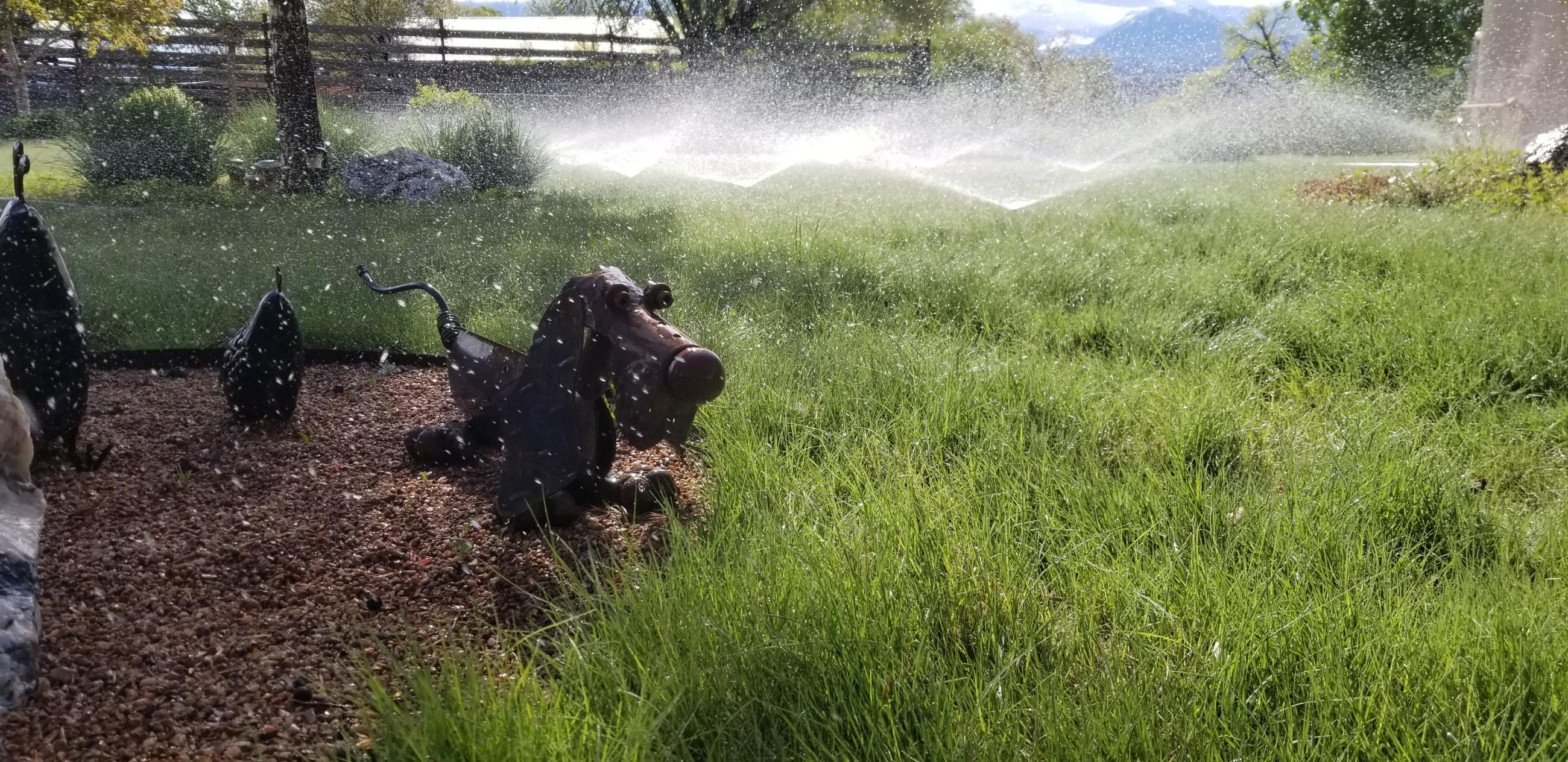


Almost everything else on the property depends on a sprinkler system. The lawn, the beds, the trees, the sod that went in last spring — all of it lives or dies on whether water arrives where it is needed, in the right amount, without anybody having to think about it. A property without a system has the decision made for it: what can be planted, and what will not survive the first August, is set by how water gets there.
The problem is older than the lawn
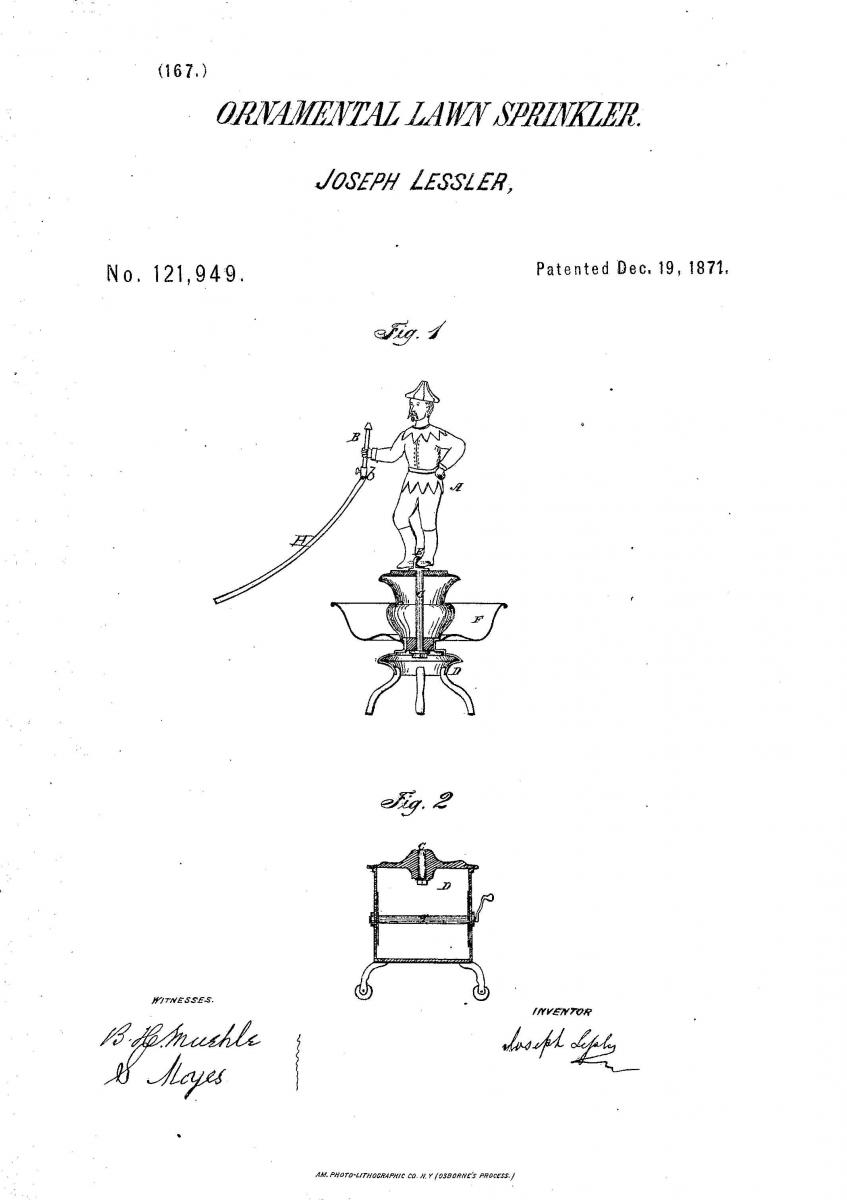 In December of 1871, a man named Joseph Lessler in Buffalo, New York patented what the Patent Office recorded as an Improvement in lawn-sprinklers. It was a stand, a nozzle and a length of hose running to the hydrant. The reason he gave for building it is the part worth reading: he wanted a way to water a lawn "without requiring the constant attention of an attendant."
That is this entire trade, written down a hundred and fifty years ago. Everything since has been a better answer to the same complaint — somebody has to stand out here holding a hose.
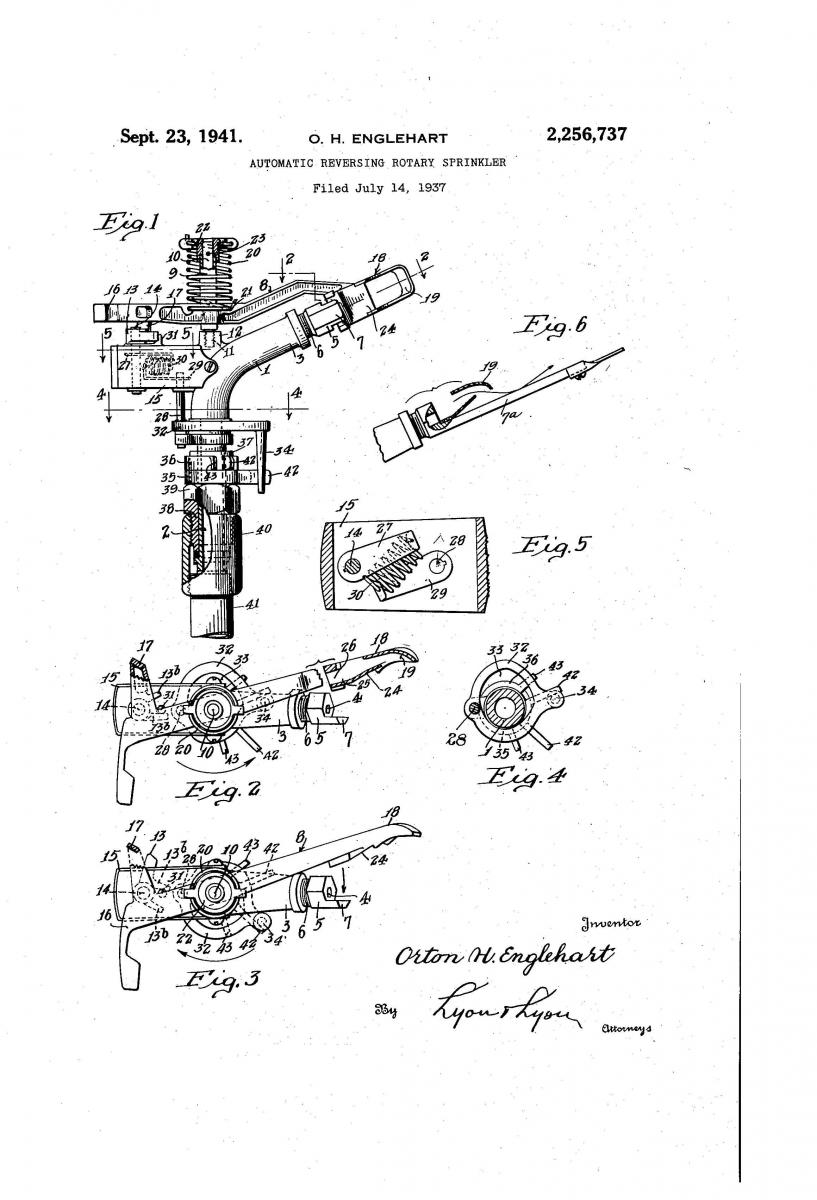 Sixty years later a citrus grower in Glendora, California named Orton Englehart worked out the next piece of it. His impact drive used a spring-loaded arm to knock the head around in a circle, one click at a time, covering ground no fixed nozzle could reach and doing it on water pressure instead of a motor. He sold the design to Clem and Mary LaFetra, who put it on the market under the name Rain Bird. The clicking you still hear across a hayfield in July is his.
The equipment got better. The problem did not change.
A system running on a controller and a schedule is still doing what Lessler wanted. What changed is that a modern system can fail in ways a man with a hose could not. A zone runs at four in the morning and nobody is awake to see it. A head settles an inch below grade and waters the fence for a month. A valve weeps into a clay hillside all summer and the first sign of it is a dead patch, or a water bill.
A system that is never looked at does not announce its problems. It just quietly costs more and waters less.
What we do
Our irrigation crews and our landscape crews work the same properties, which means the people installing a system are working from the same plan as the people planting into it.
- Design — laying out zones, heads and pressure for the property as it will actually be planted
- Installation — new systems, and additions to systems that have outgrown their original layout
- Spring startup — bringing the system back up, zone by zone, and finding what the winter broke
- Mid-season checks — the visit that catches a sunk head or a weeping valve before it becomes a dead lawn
- Repair — heads, valves, lines, wiring and controllers, quoted per case
- Winterization — blowing the system out before the first hard freeze
What this valley does to a sprinkler system
This is a semi-arid place. A landscape here does not live on what falls out of the sky, which is why the system is not an amenity — it is the thing keeping the property alive from May through September.
The season is short at both ends, and it is shorter at elevation than it is on the valley floor. A system here works hard for roughly seven months and then has to be completely emptied before the first hard freeze, because water left standing in a lateral or a brass body splits it. That deadline is set by the weather rather than the calendar, which is why winterization gets scheduled early and in route order rather than whenever somebody remembers.
Where the water in this valley actually comes from
The Uncompahgre Valley is dry country. The river running down the middle of it was never enough to farm on, and by the end of the 1800s the people trying to were watching crops burn up in a valley with a far larger river running past them — the Gunnison, at the bottom of a canyon nobody could get water out of.
So they went through the mountain. Between 1905 and 1909 the Bureau of Reclamation drove a tunnel from the Black Canyon of the Gunnison into the Uncompahgre Valley: 30,650 feet of rock, five and eight tenths miles, and at the time the longest irrigation tunnel in the world. President Taft came out in 1909 to dedicate it. It is a National Historic Civil Engineering Landmark and has been on the National Register since 1979.
It is also still running. The Uncompahgre Valley Water Users Association has operated it since 1932, and the system it feeds — seven diversion dams, 128 miles of main canal, 438 miles of laterals — puts water on roughly 76,300 acres, from Montrose thirty-four miles down the river to Delta.
That is the water in the ditch behind a great deal of property in Montrose County and on down the river into Delta County. The reason there is a lawn to irrigate in this valley at all is a hole somebody put through a mountain a hundred and twenty years ago.
The Surface Creek side of Delta County — Cedaredge, Eckert, Orchard City — is a different story. That water comes off the Grand Mesa rather than through the tunnel. Both are ditch water, and both behave nothing like what comes out of a tap.
Ditch water systems
A good deal of property in these two counties does not irrigate off the tap. It irrigates off shares in a ditch, and a system running on raw water is a different animal from one running on treated municipal water.
The reason to do it is straightforward. Ditch water costs a fraction of what treated water costs, and across a season on anything larger than a small lot the difference is not small. If a property came with shares and the landscape is being watered off the house line, the owner is paying twice for the same grass.
What makes it different is that the water is not clean. Raw water carries silt, sand, algae, moss and weed seed. Standard residential irrigation equipment is not built for any of that. Nozzles plug. Drip emitters foul within weeks. Grit works into valve seats until they will not close all the way, which produces a valve that weeps day and night and a homeowner who cannot work out why one corner of the yard is always wet.
So a ditch-fed system needs things a municipal system does not:
- A pump. A ditch delivers water, not pressure. That means a pump, sized to the property and the lift, and a pump is its own piece of equipment to protect, service and winterize.
- Filtration matched to the water. Screens, discs, sand separation, sometimes a settling tank ahead of everything else. This is the component that decides whether the system still works in August.
- Filters that actually get cleaned. A neglected filter starves the system, and it looks exactly like a failing pump — which is how people end up pricing a pump they did not need.
The season belongs to the ditch company, not to the weather. Water comes on when they turn it on in the spring and it stops when they shut it down in the fall, which is frequently while it is still hot and the lawn still wants water. A landscape planned around ditch water has to account for that gap rather than discover it. Rotation matters too: if the shares deliver on set days, the controller gets built around the ditch schedule instead of around what the plants would prefer.
One thing here is not optional. Ditch water and domestic water must never be able to mix. A cross-connection between a raw water system and the house line is precisely the failure that backflow assemblies exist to prevent, and it is why these systems are tested.
We design, install and service ditch-fed systems, and we winterize them — which is more work than a municipal system, because the pump, the intake and the filtration all have to come out of the winter intact along with everything buried in the yard.
Backflow prevention
Every system that ties into a domestic water line has an assembly on it keeping irrigation water from being drawn back toward the tap. Most water providers require that assembly to be tested every year, by a certified tester. We are certified by the American Backflow Prevention Association and we file the paperwork with your provider. More on backflow prevention and the device types we see here.
Getting a number
Installation and design are priced by the property — its size, its slope, its water source, and what is going to be planted on it. Repairs are quoted per case, because what a system needs in a given year is not knowable in advance. We will look at it and give you a number before anything is scheduled.
Get a Free Estimate or call 970-835-9661